
A section of industry may need to begin compliance immediately, even as most states are yet to notify their rules.
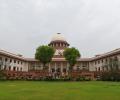
The Supreme Court, in a 6:3 majority verdict, has ruled that the expansive, labour-friendly definition of 'industry' from its 1978 Bangalore Water Supply and Sewerage Board judgement will not be used for interpreting the Industrial Relations Code of 2020. However, the 'triple test' from the 1978 verdict will still apply to pending cases under the now-repealed 1947 Industrial Disputes Act.
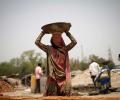
In a historic decision, the government on Friday announced the implementation of the four Labour Codes, which rationalised 29 existing labour laws, with immediate effect. The four labour codes are -- the Code on Wages, 2019, the Industrial Relations Code, 2020, the Code on Social Security, 2020 and the Occupational Safety, Health and Working Conditions Code, 2020.

Companies would have to recognise the increase in gratuity liability arising from new labour codes in their interim financial statements and results for the period ending December 31, the Institute of Chartered Accountants of India (ICAI) has said in its FAQs on the new labour codes.
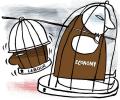
The new labour Codes, notified by the central government in November 2025, have pushed up employee costs for private-sector banks and insurance companies, with these firms reporting higher operating expenses in the October-December quarter (Q3FY26) due to the statutory impact of the new labour Codes.
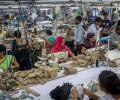
While the move may give a competitive edge over rivals like Bangladesh in the global market, several industry bodies raised concerns that many state governments may not implement it on the ground.

For MSMEs the transition could mean higher wage bills and tougher compliance -- unless strong handholding follows reports Auhona Mukherjee.
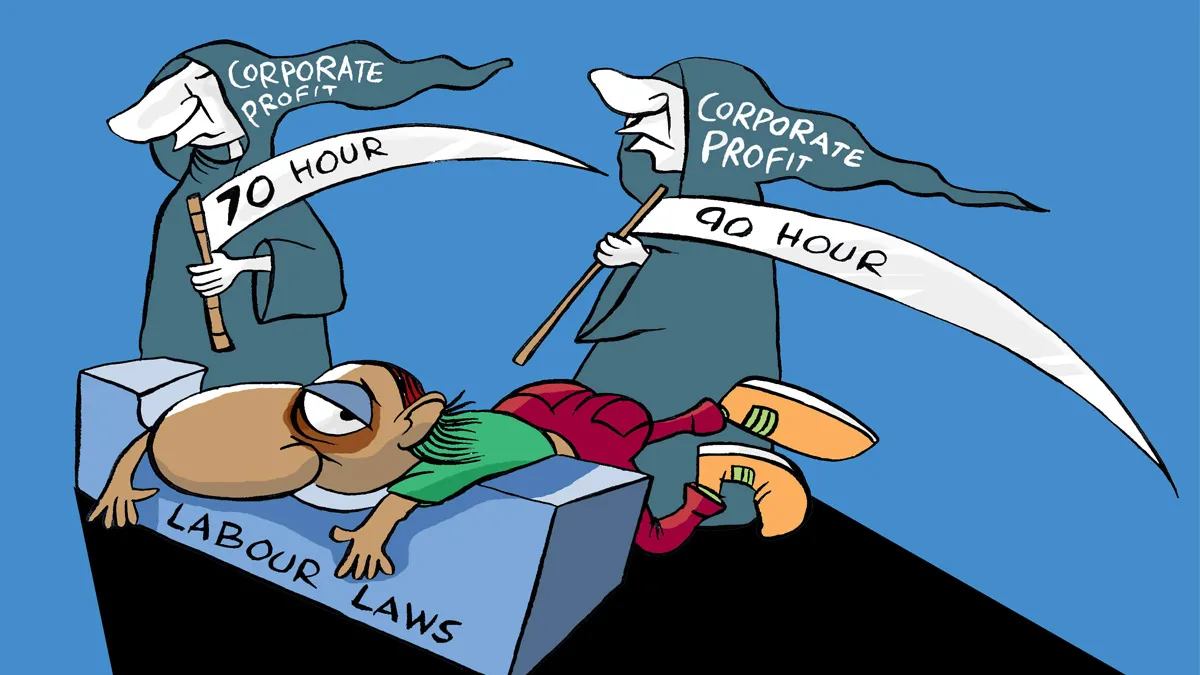
The Indian government has notified final rules under four labour codes, potentially enabling a four-day workweek in certain sectors by capping weekly working hours at 48 while allowing daily flexibility. This move also introduces significant changes to wage fixation, compliance obligations, and social security norms.
'It will increase the contribution to gratuity, which is something the employer has to give.'

'Raising the retrenchment, layoff and closure threshold to 300 workers for prior government permission enables hire-and-fire in more than 90 per cent of the Indian workplaces. More than 12,00,000 disputes are now pending for adjudication with an average disposal period ranging from 3 to five years for more than 75 per cent of the disputes.'

From appointment letters becoming mandatory to gig workers receiving social security to enhanced rights for women and contract labour, the changes reflect India's attempt to balance ease of doing business with stronger worker welfare.

Cigarette-to-soap conglomerate ITC on Thursday reported a consolidated net profit (attributable to owners) of Rs 4,931.19 crore for the third quarter (October-December/Q3) of 2025-26 (FY26), affected by a one-time provision related to the new labour codes and a base effect from an exceptional item in Q3 of 2024-25. In the year-ago period, net profit had stood at Rs 4,934.8 crore.

Trade unions have decided to launch a phased, consistent struggle to press for the withdrawal of the labour codes and go on a countrywide general strike in February next year, a statement said on Tuesday. The date of the strike will be announced on 22nd December 2025 in the next meeting of the joint forum of central trade unions, a statement said.

IT services major Wipro on Friday reported a 7 per cent decline in consolidated net profit to Rs 3,119 crore in the third quarter of FY26, weighed by a one-time provisional impact of Rs 302.8 crore due to the implementation of new Labour Codes.

Infosys on Wednesday reported a one-time exceptional hit of Rs 1,289 crore on account of the impact of the implementation of new labour codes, as India's second-largest IT services firm announced its December quarter earnings.

IT services firm HCLTech on Monday reported a 11.2 per cent decline in consolidated net profit to Rs 4,076 crore in the October-December quarter of FY26.

Micro, small and medium enterprises (MSMEs) have expressed significant concerns regarding the labour ministry's recent clarifications on labour codes, citing ambiguity in wage calculation and implementation, which they argue creates interpretational and operational challenges for employers.

India's largest airline IndiGo on Thursday reported a 78 per cent decline in December quarter net profit at Rs 549.1 crore as flight disruptions and implementation of the new labour code took a toll on its earnings. The airline reported a net profit of Rs 549.1 crore in the October-December quarter, compared with Rs 2,448.8 crore earnings in the year-ago period, according to a company statement.
The four labour codes are unlikely to be implemented this fiscal in view of slow progress on the drafting of rules by the states and also for political reasons like elections in Uttar Pradesh, a source said. The implementation of these laws assumes significance because once these are implemented there would be reduction in take-home pay of employees and firms have to bear higher provident fund liability. "The ministry of labour is ready with the rules under the four labour codes. But the states have been slow in drafting and finalising those under new codes.
The four labour codes on wages, social security, industrial relations and occupation safety, health and working conditions are likely to be implemented by the next fiscal year as at least 13 states have pre-published draft rules on these laws, a senior official said. The Centre has already finalised the rules under these codes and now states are required to frame regulations on their part as labour is a concurrent subject. A senior official said that the four labour codes are likely to be implemented by the next fiscal year.

Economists highlight that resolving domestic policy bottlenecks, particularly through land reforms and improving the ease of doing business, will be critical for Prime Minister Narendra Modi's 'next-generation reforms' and India's economic transformation towards its 'Viksit Bharat' vision for 2047.
Union Labour Minister Bhupender Yadav has exuded confidence that four labour codes, which would bring another wave of reforms, will soon be implemented as around 90 per cent of states have already come out with draft rules. In 2019 and 2020, 29 central labour laws were amalgamated, rationalised and simplified into four labour codes, viz, the Code on Wages, 2019; the Industrial Relations Code, 2020; the Code on Social Security, 2020; and the Occupational Safety, Health & Working Conditions Code, 2020, noted the Survey. During an interaction, Yadav told reporters that around 90 per cent of the states have already published draft rules on four labour codes and he expects the four legislations would become operational soon.

A new report by ADP reveals that one in two Indian companies plan to adopt AI-powered payroll systems within the next 12 months, driven by the need for automation in workforce management, compliance, and compensation decisions. However, firms are increasingly cautious about data protection risks, especially with the implementation of the Digital Personal Data Protection (DPDP) Act, 2023.

India's Code on Wages mandates strict payout deadlines, two-day full and final settlements, universal wage coverage and capped deductions to safeguard employees and enhance payroll transparency nationwide.

Their implementation is expected to create investment owing to improving ease of doing business as well as initiating pro-worker measures.
The four labour codes will not come into effect from April 1 as states are yet to finalise the relevant rules, which means that there will be no change in take home pay of employees and provident fund liability of companies for now. Once the wages code comes into force, there will be significant changes in the way basic pay and provident fund of employees are calculated. The labour ministry had envisaged implementing the four codes on industrial relations, wages, social security and occupational health safety & working conditions from April 1, 2021. The ministry had even finalised the rules under the four codes.
All four labour codes are likely to be implemented in one go from April 1, the beginning of the next fiscal year, labour secretary Apurva Chandra said on Wednesday. The parliament in its just concluded session passed three labour code bills: the Industrial Relations (IR) Code, the Social Security Code, and the Occupational Safety, Health and Working Conditions Code (OSH). The Wage Code Bill, 2019 was passed by the parliament last year.
SIS Ltd, a security and facility management services provider, aims to cross Rs 20,000 crore in revenue by FY27, driven by strong double-digit growth, expansion of its service network, and a simplified regulatory framework under new labour codes, said its Group Managing Director Rituraj Sinha.
The implementation of four labour codes in one go from April 1 next year will usher in a new wave of reforms in industrial relations and also help in attracting more investments but employment generation will remain a key challenge in 2021. This year has also been a challenging year for the work force as well as for employers due to the outbreak of the COVID-19 pandemic. The government imposed a nationwide lockdown from March 25, which had an adverse impact on economic activities and resulted in exodus of migrant workers from large cities to their homes in the hinterland. Many migrant labourers lost their jobs and it took months for them to return back to their work places from their native places.

An independent study reveals that while Geographical Indication (GI) registration has boosted the identity of Kerala's traditional handloom products, it has not uniformly translated into economic benefits across weaving clusters. Challenges include an ageing artisan population, competition from powerloom products, rising raw material costs, and inadequate marketing.

'Rather than deploying all their money at once, investors should invest gradually.' 'A staggered approach is the better strategy because volatility is likely to persist.'
A Dalit labourer was allegedly abducted, strangled, and his body dumped in a canal in Muzaffarnagar, Uttar Pradesh, following an altercation. Police have arrested one suspect and are investigating the case.

Two of the three strikes are related to the gig economy, a centrepiece of the new labour Codes.

'Workers are the people who create all the wealth in this country. How can you call them anti-national?'

AICC General Secretary K C Venugopal has released an open letter to Kerala Chief Minister Pinarayi Vijayan, alleging secret deals with BJP leaders and the central government, raising questions about the LDF government's functioning ahead of the Assembly elections.

The Maharashtra government has initiated action against those involved in an alleged job fraud targeting fresh graduates with the promise of jobs at Hinjewadi IT Park in Pune. The government is also working on regulations to address forced resignations and layoffs in the IT sector.

Former poll strategist Prashant Kishor made a stunning electoral debut by winning Bihar's Bankipur assembly seat, a long-held BJP bastion. Concurrently, the Congress retained the Datia assembly seat in Madhya Pradesh, while the BJP successfully held onto the Manjalpur seat in Gujarat, showcasing mixed results for the ruling and opposition parties in these crucial by-elections.

Commerce and Industry Minister Piyush Goyal announced that India expects to operationalise nine free trade agreements (FTAs) within the next 10 months, with plans for an additional three to four significant pacts over the coming year, reinforcing India's ambition to become a global manufacturing and investment hub.

HDFC Life Insurance reported a 4 per cent year-on-year increase in net profit to Rs 495.6 crore for Q4FY26, while its parent, HDFC Bank, announced a Rs 1,000 crore preferential share issuance to raise its stake to 50.5 per cent.

Various reforms, including GST, labour codes, and quality control order, have been rolled out since August 15.
